


World Pride 2025, the largest LGBTQ+ celebration in history, has come to Washington, D.C., with over 300 events stretching across three weeks. Organizers are emphasizing messages of "resistance, resilience, and hope" as hundreds of thousands gather in the nation's capital. But here's what you probably didn’t realize about the significance of the occasion and its venue: D.C. is the birthplace of drag itself. And America's first drag queen was a Black man born into slavery.
His name was William Dorsey Swann, and for nearly a century, history tried to erase him completely.

I'm fighting to document stories like Swann's before they're dismissed as "liberal hysteria" or erased entirely, and I need your help!
With no corporate backing or wealthy sponsors, this work depends entirely on readers like you.
If everyone reading this became a paid subscriber, I could investigate these hidden histories full-time, but right now less than 3% of my 25,000 followers are paid subscribers.
If you believe in journalism that uncovers the radical roots of liberation movements, please consider a paid subscription today!
The Forgotten Queen of Freedom
While millions celebrate Pride this month, Ryan Bos, executive director of the Capital Pride Alliance, tells ABC News that this year feels "more important than ever" as the Trump administration targets LGBTQ+ communities. But Swann understood dangerous times. In the 1880s, he was throwing clandestine drag balls in D.C., and getting arrested for it.
Picture this: It's April 12, 1888. Police storm a house party in Washington, D.C., and find thirteen Black men "dressed in elegant female attire": silk dresses with trains, corsets, bustles, the works. As officers barge in, one man rushes toward them, boldly telling the police lieutenant, "You is no gentleman." His "gorgeous dress of cream-colored satin" gets torn to shreds in the ensuing brawl. The Washington Post identifies him as William Dorsey, "who was the 'queen.'"

That moment was one of the first documented instances of violent resistance in the name of LGBTQ+ rights. And it happened eighty-one years before the more widely known Stonewall riots.
From Plantation to Queen's Court
Swann's story starts where so many stories of Black resistance begin: in bondage. Born around 1858 in Washington County, Maryland, he was enslaved by a white woman named Ann Murray. When Union soldiers marched through in 1862 though, everything changed. The D.C. Compensated Emancipation Act had freed over 3,000 enslaved people in the capital, and thousands of Black Americans flocked to Washington, transforming it into a center of Black political and cultural life.
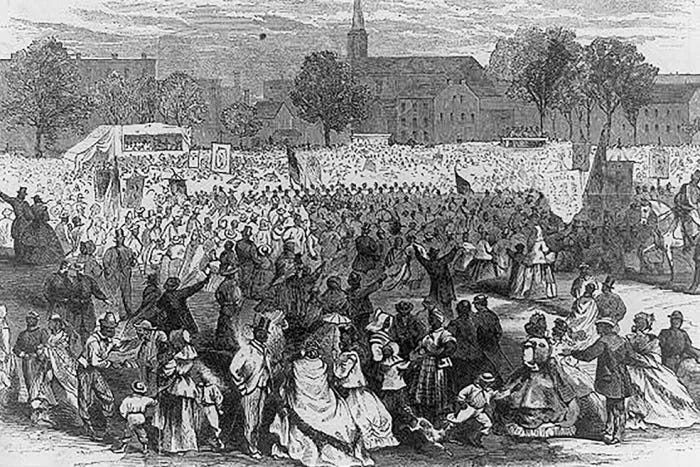
By 1880, Swann had moved to D.C., where he worked as a janitor and sent money home to his family's farm. But at night, he was building the first documented drag balls in American history.
These parties were acts of radical self-determination. Swann's guests, including messengers, butlers, coachmen,and cooks, donned women's clothing and men's suits, dancing to folk music in secret gatherings. The centerpiece was a "resistance dance" called the cakewalk, performed initially by enslaved people to secretly mock their masters' ridiculous mannerisms. White enslavers, oblivious to the satire, would award cakes to the best dancers. Now free, Swann's community continued to use performance to claim power and joy.
Swann crowned the dance winners "queen of the ball,” inspired by the "queens of freedom" who led D.C.'s annual Emancipation Day parades. He started calling himself "the Queen" too, combining two cultural traditions into something entirely new. Thus, the drag queen was born.
The Price of Visibility
But visibility came with a cost. This was Reconstruction America, where Black men were supposed to perform respectable masculinity to survive. As one historian notes, there was "very little patience for men who subverted gender norms" in the post-Civil era.
The newspapers loved the spectacle, printing arrestees' names and turning them into objects of public scorn. Dr. Charles Hamilton Hughes described Swann's group in medical journals as "an organization of colored erotopaths" and a "lecherous gang of sexual perverts." The criminalization was swift and brutal, with sentences ranging from three to ten months for the "crime" of attending a drag ball.
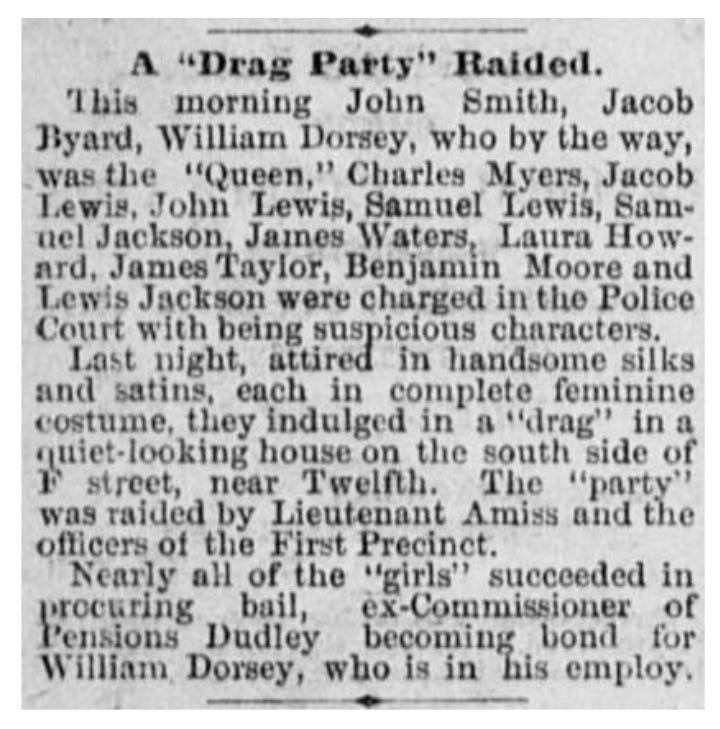
The raids kept coming in the following years. Swann himself spent time in jail for stealing party supplies. But the most devastating blow came in 1895, when authorities arrested him for "keeping a disorderly house": code for running a brothel, though he pleaded not guilty. The court sentenced him to 300 days.
After serving three months, Swann petitioned President Grover Cleveland for a pardon, an unprecedented move. Thirty friends signed the petition in solidarity. U.S. Attorney A.A. Birney argued against it, calling Swann's conviction "the most horrible and disgusting offense known to the law; an offense so disgusting that it is unnamed."
Cleveland denied the petition. Nonetheless, Swann's failed petition represents the earliest documented case of an American activist taking "specific legal and political steps to defend the queer community's right to gather without the threat of criminalization, suppression or police violence." He was fighting for their right to exist and to celebrate that existence, more than a century ago.
The Roots of Everything We Know
Swann's influence didn't die with his retirement in 1900. His younger brother Daniel J. Swann continued providing costumes for D.C.'s drag community until his death in 1954, spanning five decades of queer culture. The basic format Swann created, characterized by competitive walking dances with exaggerated gestures and organized around family-like groups led by "mothers" and "queens", survives today in ballroom culture.
Those phrases you hear on "RuPaul's Drag Race" and "Pose", such as "Strike a pose," "sashay across the floor," "vogue"? They trace back to descriptions of 1930s balls that descended directly from Swann's house parties. The underground networks, the chosen family structures, and the transformation of domestic spaces into sites of resistance and joy all started with a formerly enslaved man throwing parties in post-Reconstruction D.C.

This history matters because it shatters the sanitized narrative of LGBTQ+ progress. Swann wasn't asking for acceptance or trying to prove he was "just like everyone else." He was creating space for radical self-expression in a world that wanted him dead. His drag balls were about surviving through community, and the audacious belief that Black queer people deserved joy.
Hiding in Plain Sight
For nearly a century, Swann was lost to history. It wasn't until 2005 that journalist Channing Gerard Joseph stumbled across a Washington Post article from 1888 while browsing an online newspaper database. His years of archival research revealed what he calls the nation's first "queer American hero": someone who was literally "hiding in plain sight" in newspaper records that few had bothered to examine.
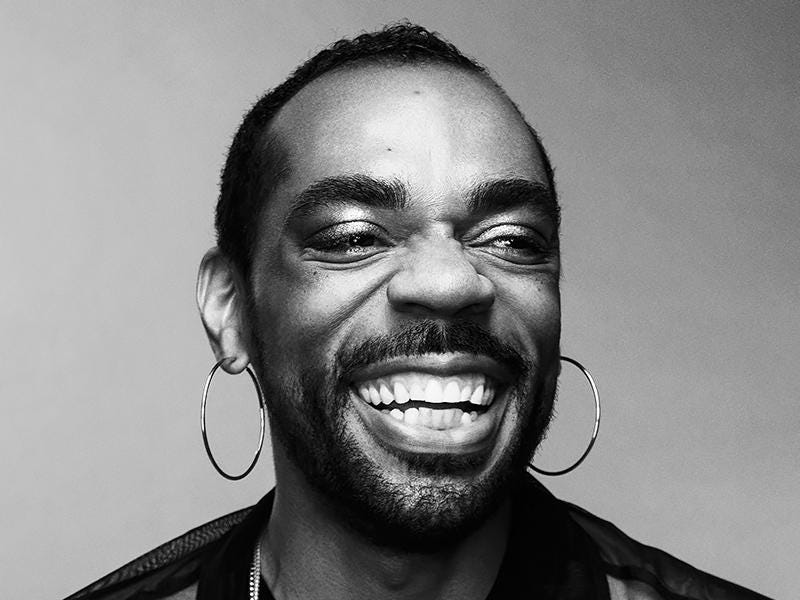
That erasure wasn't accidental. As historian Kathleen Casey explains, "LGBTQ history is hampered by the lack of diaries and personal letters and family papers, because you just don't put [those feelings] in writing." But it's also because the LGBTQ+ movement often prioritized white, middle-class narratives deemed more "palatable" to mainstream society, pushing intersectional identities to the margins.
The result was a version of queer history that starts with Stonewall and focuses on assimilation rather than the radical tradition of resistance that came before. We got marriage equality campaigns that carefully vetted plaintiffs for their respectability, making sure they were monogamous and middle-class. We got Pride parades sponsored by corporations that, as World Pride 2025 organizers admit, are now "dragging their feet" on LGBTQ+ support under the Trump administration.
Same Fight, Different Century
Today, as World Pride comes to Swann's city, the parallels are impossible to ignore. Organizers report that groups from Canada and several African countries have opted out of attending, citing Trump's anti-trans policies. Corporate sponsors who previously supported Capital Pride are backing away from World Pride 2025. Trans people report feeling like they have "targets on their backs", the same language used to describe Swann's community 140 years ago.
Swann's story teaches us that visibility has always been dangerous for Black queer people, and they've always chosen it anyway. They've always created spaces for celebration in the face of criminalization and understood that joy itself is a form of resistance.
William Dorsey Swann died in 1925, but this week, his city becomes the epicenter of global LGBTQ+ celebration. The boy born into bondage would probably love the irony. After all, he spent his whole life turning oppression into performance, survival into celebration, and erasure into visibility.
The Queen is dead. Long live the queens.
But here's the grim reality: stories like William Dorsey Swann's are disappearing faster than we can recover them.
The same sanitized, white-centered narratives that erased Swann for decades are reasserting themselves. Black queer history, the radical roots of everything we celebrate during Pride, is being pushed back to the margins.
Corporate sponsors who funded LGBTQ+ archives are quietly backing away. Universities that started Black queer studies programs are freezing funding, afraid of becoming targets. Even major institutions are proving they can't protect intersectional histories when political pressure mounts.
The reality is stark: if we don't document these stories ourselves, they vanish. Again.
Right now, less than 3% of my followers are paid subscribers. Imagine what we could uncover with more support:
🏛️ At 5% paid subscribers: I could spend weeks in archives across the country, searching for more stories like Swann's hidden in forgotten newspaper databases.
📚 At 10% paid subscribers: I could interview elderly Black queer activists before their firsthand accounts of ballroom culture's origins are lost forever.
🎭 At 20% paid subscribers: We could create a comprehensive digital archive of Black queer resistance that can't be defunded or dismantled when administrations change.
I'm going to be direct: You might think someone else will step up to contribute to this page, but that's exactly what everyone else is thinking too. This only works if each one of us contributes what we can, which is just the cost of a coffee each month.
This isn't just about keeping a newsletter alive. It's about ensuring that the next generation knows their liberation started with a formerly enslaved man throwing parties in the face of police raids, fighting legal battles he knew he’d lose, and calling himself a queen when the world told him he was nothing.
The canaries are still singing. Will you help amplify their voices?
If you are having trouble upgrading your subscription with the above link, visit historycanthide.substack.com/subscribe
Addition: Some of you preferred a one-time donation over a full subscription. To do that you can "Tip" me on Venmo (TheGenZHistorian) or Cashapp ($kahlilgreene00).
References:
Haner, Joanne. "'We see you': In Trump-era Washington, World Pride 2025 organizers aim to bring 'hope' to LGBTQ+ community." ABC News, June 2, 2025.
Shane, Cari. "The First Self-Proclaimed Drag Queen Was a Formerly Enslaved Man." Smithsonian Magazine, June 9, 2023.
Joseph, Channing Gerard. "The First Drag Queen." American Academy in Berlin, 2020.
"Against the Erasure of Black Queer History." The Trevor Project, February 13, 2024.
Laneri, Felix. "Black LGBTQ Activists, History Erased." 540WMain, February 17, 2022.
Greytak, Emily, et al. "Policing Progress." American Civil Liberties Union, April 30, 2024.
Guzman, John, and Ella Wiley. "Rebellion and Pride: How Police Have Failed LGBTQ+ Communities." NAACP Legal Defense and Educational Fund, 2025.
Wow ! I didn't know this, and I bet most people don't. You're right, this and other stories need to be preserved, before they are [sometimes intentionally] lost. Thanks for this ! Subscriber in Virginia
I am surprisingly STUNNED! Those of us who reside in (or near, like me) the NYC area are of the belief that this movement was started by our lighter persuasion brothers and sisters-- But how was I fooled! "Let me count the ways!" Great story!